Valentine’s Day Jewelry Packaging: The Complete B2B Guide
Valentine’s Day jewelry packaging should be decided eight weeks before February 14: choose a velvet or foil-finished structure in the rose-and-gold palette, size the insert to the exact product, and get sea freight moving by week five. In this guide we cover the trends that matter for 2026, box recommendations by product type, personalization options, realistic budget tiers, and a working-backwards production timeline — based on what we manufacture every season at Qdylc for jewelry brands in the US and Europe.
For jewelry brands, Valentine’s Day is not a small holiday. It typically drives 15–20% of annual jewelry orders, second only to Q4. And unlike Christmas, the buying window is short and concentrated: most orders are placed in the ten days before February 14. That means your packaging has to be in your warehouse — not on the water — by early February, which pushes every decision two months upstream.
Valentine’s Packaging Trends
Four trends are shaping Valentine’s jewelry packaging this season. Each one is visible in what DTC brands are actually ordering, not just in mood boards.
1. Velvet is back. After several years of matte kraft dominance, velvet-wrapped rigid boxes are returning — especially in deep rose, wine and blush tones. Velvet photographs with depth under phone lighting, which matters when customers share unboxings, and it pairs naturally with gold foil. For brands at the $80–250 price point, velvet magnetic boxes are now our fastest-growing Valentine’s structure.
2. Rose red and gold — used sparingly. The winning palette is not full-coverage red. It is a neutral base (cream, blush, charcoal) with one red or rose-gold accent: a foil logo, a ribbon, an inner-lid print. Full red boxes look seasonal and get discarded; neutral boxes with red accents stay in use year-round, which customers notice.
3. Heart-shaped boxes are back — as an accent, not a default. Heart-shaped ring boxes sell strongly as a limited Valentine’s SKU. The smart execution: keep the heart on the outer sleeve or lid, and use a standard structure underneath, so the insert still fits your regular ring inventory.
4. Reusable design. Buyers increasingly value boxes designed for a second life — a jewelry tray, a keepsake box, a travel case. A magnetic rigid box with a removable insert tray achieves this without adding cost, and it keeps your brand in the customer’s drawer instead of the recycling bin.
Packaging Ideas by Product Type
Before choosing any box, sort your Valentine’s SKUs into two groups: hero products (the ones featured in campaigns — usually necklaces and rings) get premium structures, and add-on products (earrings, thin chains) get efficient ones. Most brands over-invest in add-on packaging and under-invest in the hero unboxing, which is exactly backwards — the hero product is what appears in photos and reviews. With that split decided, here is what works per category:
Necklace Boxes
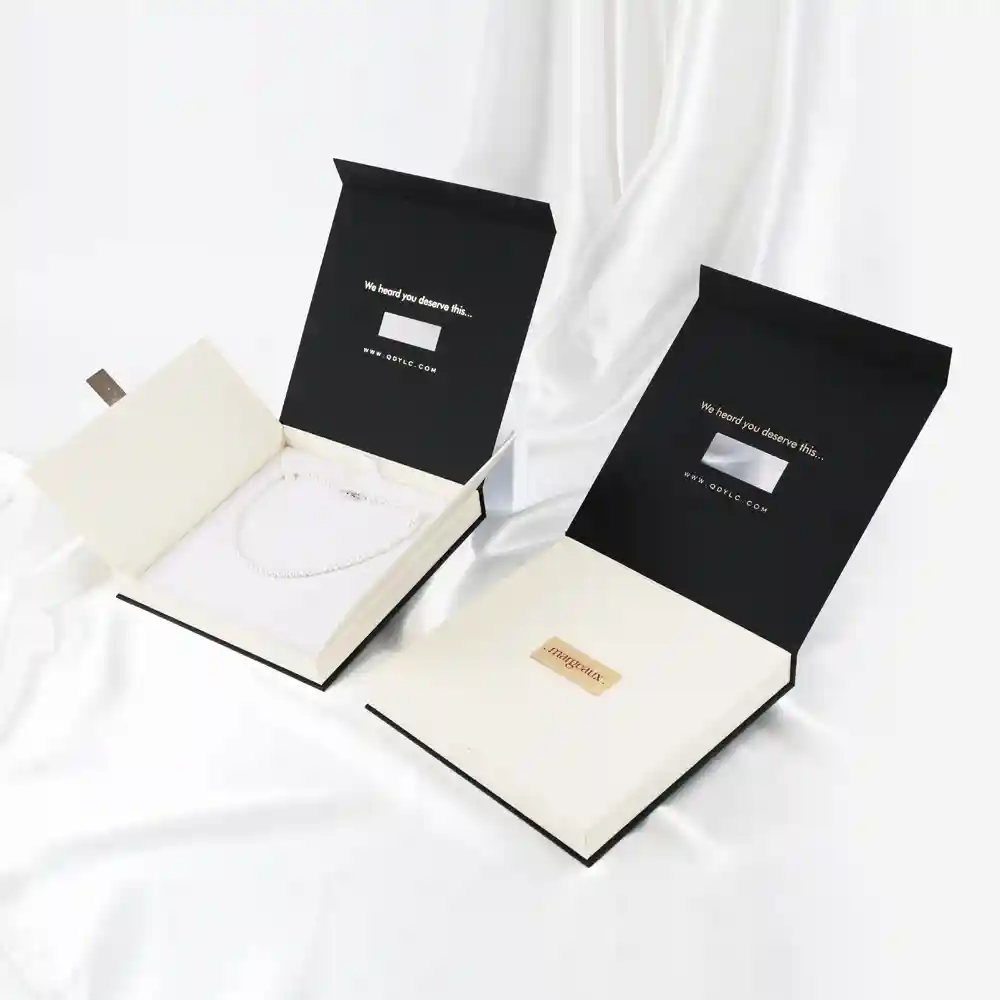
Necklaces need length and anti-tangle structure. For Valentine’s, the strongest option is a rectangular rigid box (18 × 10 × 3 cm) with a neck-model insert — the chain sits draped over a form, the pendant is centered, and the presentation is immediate on opening. For chain-only gifts at lower price points, a flat two-piece box with a chain-wrap card keeps cost near $0.50 per unit. See our necklace gift boxes.
Ring Boxes
Rings are the default Valentine’s jewelry purchase, which means shelf differentiation is hardest here. Two directions work: the classic slotted box (5.5 × 5.5 × 4 cm) in blush velvet with rose-gold foil, or the heart-lid variant for limited editions. Both use the same insert standard — a slot cut to your band width — so you can run both versions from one production tooling. Browse our custom ring boxes.
Bracelet Boxes
Bracelets need the widest insert of the four categories, and they are the most commonly under-sized. For Valentine’s, a drawer-style box (10 × 10 × 5 cm) with a rounded pillow insert presents well and survives shipping — the drawer adds an unboxing beat without the cost of a hinged lid. Use flat EVA under velvet wrap for bangles; use a rolled card insert for delicate chains.
Earring Boxes
Earrings are usually the add-on sale, so the box must be cheap, small and stackable. A two-piece box (7 × 7 × 3 cm) with a die-cut card insert holding pairs at a slight angle does the job. If studs are your main SKU, add a foam pad with paired holes — it prevents the classic “one earring loose in the box” complaint.
Personalization Options
Personalization is where “customized gift valentines” searches convert — buyers want the package to carry the couple’s details, not just the brand’s.
- Foil-stamped name or date. Hot stamping a name, initials or a date on the lid is the highest-impact option. On our digital-foil line it requires no die, so short runs and even one-off names are viable — the reason brands can offer “add a name” at checkout without holding inventory.
- Inner-lid cards. A printed card inside the lid carries a longer message at near-zero cost. It also solves a production reality: lid printing locks your artwork weeks earlier, while the card can be printed later and inserted by your fulfillment team.
- Printed ribbon. 15–25 mm satin ribbon with a repeating logo or “Happy Valentine’s Day” text runs from 500 meters per design. It ties the whole unboxing together and works across every box type in the same collection.
- Wax seals and stickers. For lower-budget lines, a branded seal sticker on the tissue fold delivers 80% of the wax-seal effect at 2% of the cost.
One production note worth knowing: digital foil and die-stamped foil are different processes. Die-stamped foil produces the sharpest, most raised result but requires a brass die (typically $50–120 per design) and locks your artwork early. Digital foil has no tooling and accepts variable data — names, dates, one-off personalization — with slightly less depth. For a Valentine’s collection with fixed branding, die foil on the lid plus digital foil for names is the combination we quote most often.
Budget Tiers
| Tier | Structure & finish | Typical unit cost* | MOQ at Qdylc | Best for |
| Entry | Kraft two-piece + 1-color logo + paper insert | $0.35 – 0.80 | 100 (digital print) / 500 (full custom) | Sub-$50 products, high SKU count |
| Mid | White/blush card + rose-gold foil + EVA insert + ribbon | $0.60 – 1.20 | 500 | $50–120 products |
| Premium | Velvet-wrapped magnetic rigid + foil + velvet insert | $1.50 – 3.50 | 500 | $120+ products, hero SKUs |
*FOB Qingdao, indicative for 500–2,000 pcs; exact pricing depends on size, insert and finish. Send dimensions for a same-day quote.
The rule of thumb we give clients: packaging should run 5–10% of retail price. A $200 necklace supports a $2 box; a $40 bracelet does not. Trying to put a premium box on an entry product usually destroys the margin without lifting conversion.
Production Timeline
Work backwards from February 14:
| Week | Milestone | Notes |
| W-8 | Design finalized, quote confirmed | Free mockup within 24h of logo submission |
| W-7 | Artwork proof approved | Check foil color on actual paper stock, not screen |
| W-6 | Pre-production sample approved | 5–7 days; $30–80, refundable from bulk order |
| W-6 → W-2 | Bulk production | 15–20 days stock structure / 25–30 days full custom |
| W-5 | Sea freight must leave factory | 30–35 days to US/EU; DDP available |
| W-1 | Air/express deadline | 5–7 days; for top-ups and late orders only |
| Feb 10–13 | In warehouse, ready to ship | Buffer for customs and last-mile |
The hard gate is sea freight at W-5. Every year we see brands discover this one week too late and pay 3–4x in air freight. If your design is not finalized by W-8, switch to our low-MOQ program — stock structures with digital printing can compress the cycle by two weeks.
Pre-Order Checklist
Ten things to confirm before you pay the deposit:
- Insert cavity sized to a real product sample — not a spec sheet photo.
- Foil color tested on the actual paper stock — rose gold shifts dramatically between coated and uncoated stock.
- Inner-lid message proofread twice — misprinted dates are the most common Valentine’s packaging recall.
- Box fits your shipping carton — check how many units per outer carton and the resulting freight class.
- Quantity split per SKU confirmed — running out of your best-seller’s box in week one is the most expensive mistake.
- Ribbon and tissue ordered in the same cycle — they are small but have their own lead times.
- Anti-tarnish strips included for silver lines.
- Sample quantity budgeted — 5–10 extra samples for photography and influencer seeding.
- HS codes and DDP terms confirmed — we handle export documents; confirm who clears duties on your side.
- Reorder trigger agreed — decide the stock level at which you reorder, before the season starts.
Get Your Valentine’s Packaging Quoted
Qdylc is a custom paper packaging manufacturer in Qingdao, China, producing necklace, ring, bracelet and earring boxes for jewelry brands across the US, Europe and Australia — with a 100-piece low-MOQ program, free structural drawings, mockups within 24 hours, and DDP shipping that lands your boxes duty-paid.
Start with the product you sell most: necklace gift boxes | custom ring boxes | jewelry & accessories solutions |