
How to Package a Necklace for Gifting: The Definitive Guide
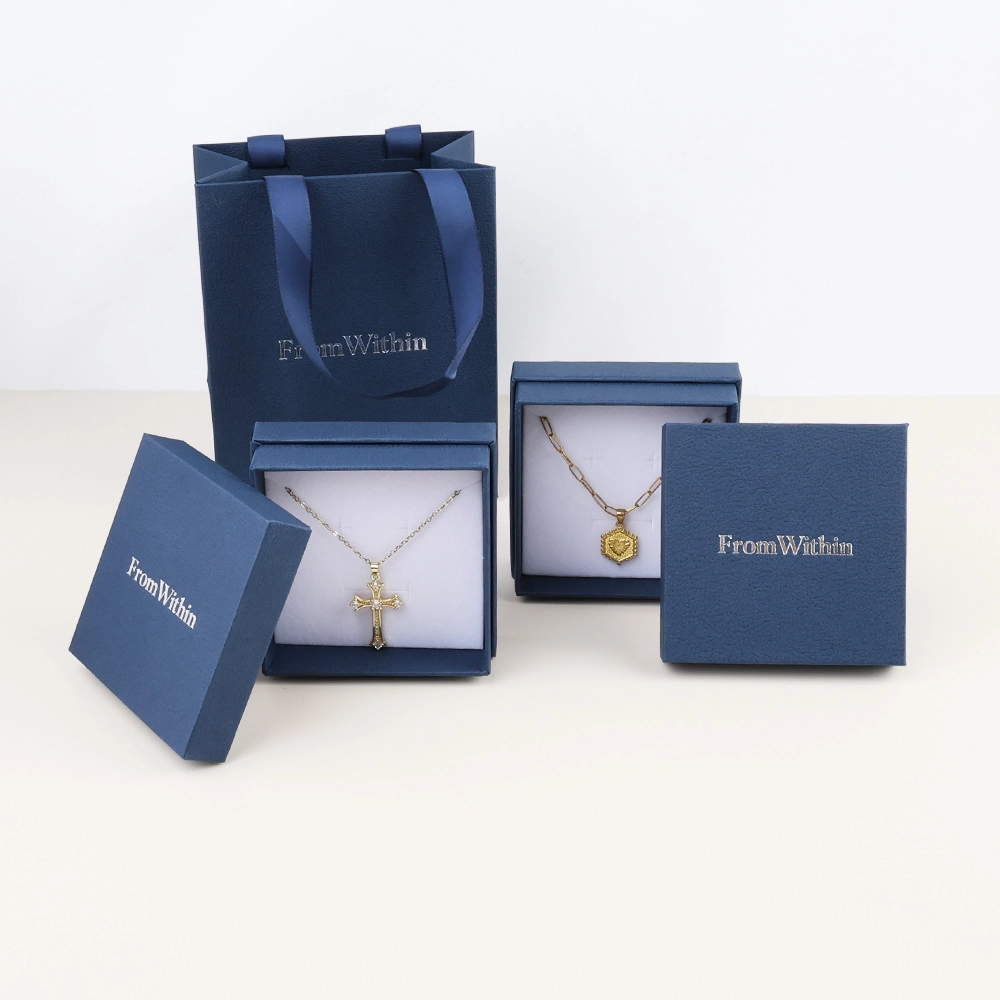
To package a necklace for gifting, solve two problems at once: stop the chain from tangling, and make the pendant the first thing the recipient sees. The reliable formula is a box with a neck-model or chain-wrap insert that holds the chain in a fixed loop, a cavity deep enough for the pendant, and one personal touch — an inner-lid print or ribbon — that turns packaging into part of the gift. This guide covers the anti-tangle options, the box types worth choosing between, sizing by chain length, and a five-minute packing routine your team can run at scale.
Necklaces are the longest, most tangle-prone jewelry category — and also the one where presentation pays off most, because a pendant centered in an open box is effectively a product photo the customer takes themselves. Get the insert right and both problems disappear at once.
The Anti-Tangle Problem
A loose chain in a flat box knots within minutes of transit vibration — and a knotted chain arrives as a complaint, not a gift. Three proven solutions:
1. Neck-model insert. A molded form (velvet-wrapped EVA or flocked board) shaped like a display bust. The chain drapes over it exactly as it would on a counter display, the pendant sits centered and gravity keeps every link separated. This is the premium standard — the unboxing looks like a jewelry store window. Trade-off: the insert needs depth, so the box is typically 4–5 cm tall.
2. Chain-wrap card. A die-cut card with two slots at the top edge; the chain threads through them and the clasps click into a bottom notch. The card holds the chain in a fixed, flat loop that cannot move. It costs a fraction of a neck model, ships flat, and works in slim boxes — the workhorse for mid-price lines. Trade-off: presentation is neat but flat, not dimensional.
3. Pendant positioning sticker or loop. For chains sold with a statement pendant, a small adhesive loop or wax-style dot on the card pins the pendant in place while the card holds the chain. This solves the most common mid-transit failure: the pendant sliding to the corner and dragging the chain into a knot behind it.
Our rule from production: chains under 1.5 mm — use a wrap card; chains with pendants — add a pendant locator; anything above a $100 retail point — use a neck model. All three inserts are standard options on our necklace gift boxes, and we cut the wrap-card slots to your actual chain gauge.
Necklace Box Types Compared
| Box type | Anti-tangle support | Presentation | Relative cost | Best for |
| Rectangular flip-top (slim) | Via wrap card | Clean, flat | Lowest | Chains & pendants, sub-$80 lines |
| Square deep box + neck model | Native — chain drapes on form | Premium, dimensional | Highest | Fine jewelry, engravable/name necklaces |
| Drawer style (tray + sleeve) | Via tray insert | Two-beat unboxing, reusable tray | Medium-high | Personalized gifts, gifting brands |
How the choice usually resolves:
- Slim rectangular flip-top is the volume workhorse. With a good wrap card it tangles no more than the others, costs 40–60% less, and ships in half the volume.
- Square deep box with neck model wins wherever the pendant is the product — name necklaces, engraved pendants, birthstone pieces. The dimensional reveal justifies itself at higher price points, and it photographs dramatically better for social sharing.
- Drawer style adds a second unboxing beat and a tray the recipient keeps. It is the structure we recommend most for personalized necklace brands, because the personalization (a name foil-stamped on the sleeve) sits exactly where eyes land first.
Sized for Chains vs Pendants
Chain length drives box length; pendant height drives cavity depth. The chart covers the common retail lengths:
| Chain length | Style | Minimum box length | Typical outer box |
| 40–45 cm | Choker / collar | 16 cm | 18 × 10 × 3 cm (wrap card) |
| 45–50 cm | Princess (most common) | 18 cm | 20 × 10 × 3 cm (wrap card) |
| 50–55 cm | Matinee | 20 cm | 22 × 10 × 3 cm (wrap card) |
| 55–60 cm | Opera | 22 cm | 24 × 10 × 3 cm (wrap card) |
| Any + pendant | Pendant styles | Chain length rule | 20 × 10 × 4–5 cm (neck model, pendant depth) |
Three sizing notes from our quoting desk:
- Measure the chain doubled, not stretched. A 50 cm chain in a gentle S-loop needs about 26 cm of card run — the wrap card folds it into a 20 cm box.
- Pendant depth is the usual miss. Add the pendant’s full height plus 3–5 mm clearance to cavity depth; a boxed pendant that presses against the lid arrives with a mirror-imprint on the velvet.
- Name-plate necklaces need width. A “custom necklace name” plate is often 25–40 mm wide — spec the wrap card slot spacing so the plate sits flat, not twisted.
Presentation Touches
Once structure and size are right, three details lift the perceived gift value:
- Opening angle. A two-piece box opened flat on a table hides the pendant behind the lid; opened at 75–90 degrees it presents like a display case. Rigid boxes with a hinged lid hold that angle naturally — worth the small premium for hero SKUs.
- Ribbon cross-tie. A 15 mm satin ribbon crossed over the closed box and finished in a flat bow adds a gifting signal at negligible cost. For personalized pieces, print the recipient’s initial on the ribbon tail instead of the box — it keeps the box reusable across orders.
- Inner-lid foil. The single highest-return detail for “necklace with name” products: the buyer’s own name or a date, foil-stamped inside the lid. On our digital-foil line it needs no die and no minimum per name, so brands can offer it as a checkout option without holding printed inventory.
One principle ties these together: the box should stage the pendant, not compete with it. Keep the lid exterior quiet and let the reveal carry the emotion.
Two finishing layers complete the gift: a sheet of tissue paper (15–17 gsm) folded over the insert before closing — it adds a soft first touch and protects the insert from fingerprints during packing — and a thin poly bag around the closed box before it goes into the shipping carton, which guards against moisture and keeps the ribbon crisp. Both cost a few cents and together they are the difference between “packaged” and “gift-wrapped.” For brands shipping direct to recipients, add a gift note card in a matching stock — it removes the need to include an invoice, which instantly breaks the gifting illusion.
Gift-Ready in 5 Minutes
A packing routine for fulfillment teams and small brands — five steps, no training required:
- Thread the chain through the wrap-card slots (or drape over the neck model), and click both clasps into the bottom notch. — 30 second
- Seat the pendant in its locator loop; confirm it sits face-up and centered. — 30 seconds
- Close the box and check: shake gently — no slide, no rattle. — 30 seconds
- Add the card and ribbon: inner-lid card face-up under the lid, ribbon cross-tied if the order is a gift. — 2 minutes
- Box into the shipping carton with 2 cm of cushioning on all sides — necklaces inherit the same three-layer shipping rule as every fine piece. — 1.5 minutes
Print these five steps as a one-page card at the packing station. The most common fulfillment error we hear about — pendant face-down in the box — disappears with step 2 alone.
Get Necklace Gift Boxes Built for Presentation
Qdylc manufactures necklace boxes with matched anti-tangle inserts — neck models, wrap cards and pendant locators, cut to your chain gauge. Free insert drawings within one business day, mockups in 24 hours, low-MOQ runs from 100 pieces, and DDP shipping to the US, EU, UK and Australia.