
How to Package Bracelets and Bangles: Sizes, Inserts, and Box Types
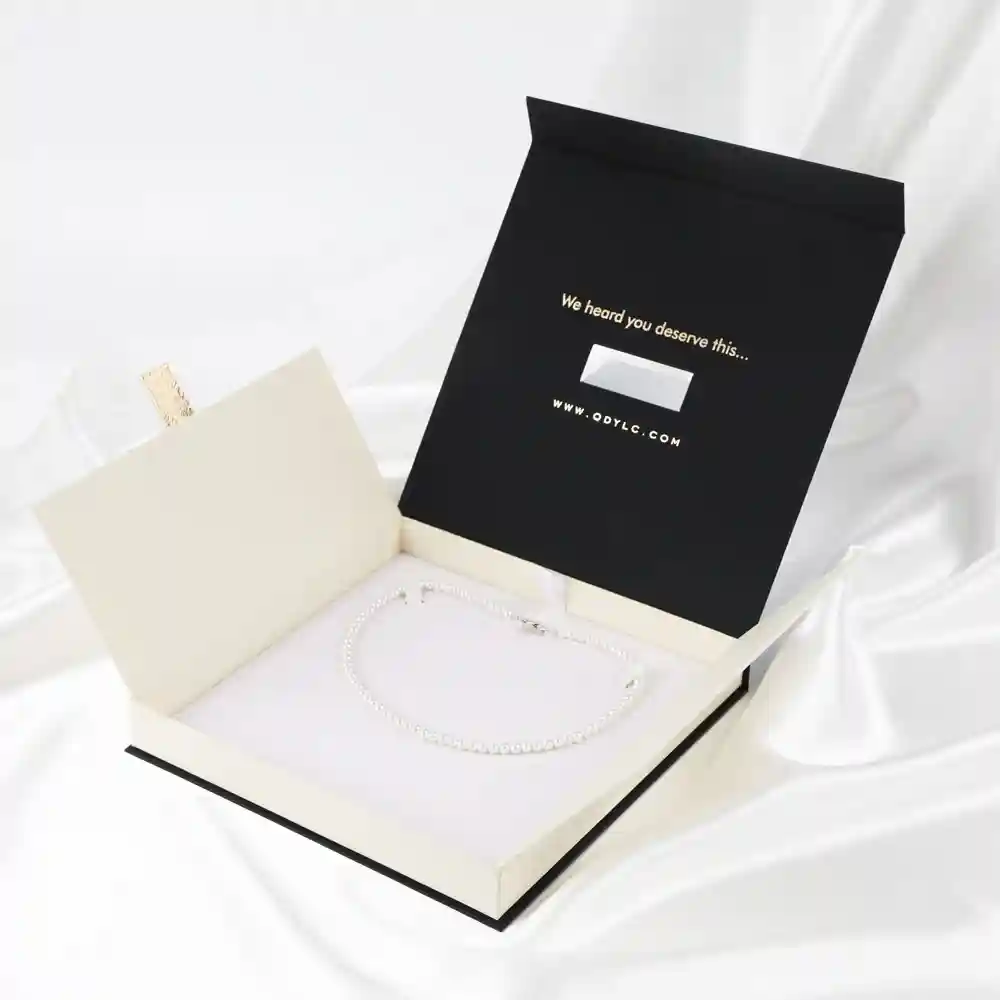
To package bracelets and bangles correctly, match the insert to the bracelet’s inner diameter — which ranges from 55 mm for a small bangle to 75 mm for a large one — then pick a box structure that protects the widest point of the piece. Bracelet packaging is more complex than ring packaging precisely because of this size spread: one brand’s “standard” bracelet can be another brand’s oversized bangle. This guide covers the four bracelet types, a working size chart, the three insert options, four box styles, and the special case of medical ID bracelets — based on what we manufacture at Qdylc for jewelry brands in the US and Europe.
Know Your Bracelet Type First
The bracelet determines the box, not the other way around. The four categories behave completely differently in a box:
- Chain bracelets. Light, flexible, prone to tangling. They need an insert that holds them in a visible loop — a rounded pillow or a formed card — and enough cavity depth that the clasp does not press on the lid. Protection priority: anti-tangle, anti-scratch.
- Bangles (rigid). A solid circle of metal that cannot flex. The insert must cradle it flat on a full ring-shaped recess, and the box must be deep enough for stacked or engraved bangles. Protection priority: scratch prevention on large polished surfaces — the single most complaint-generating surface in the category.
- Woven and leather bracelets. Thicker, textured, often with metal hardware at the ends. They tolerate pressure better than chains but dislike tight rolls that crease leather or distort weave. See our dedicated guide: how to package leather bracelets.
- Medical ID bracelets. Functional, often stainless steel or silicone, and frequently bought for someone else. They need secure hold plus space for the information card that ships with them — covered in detail below.
Identify your type before quoting any box. We ask for this first on every bracelet packaging inquiry, because a “bracelet box” quoted for chains will not hold bangles, and vice versa.
Standard Bracelet Box Sizes
Work from circumference to insert to outer box. The chart below covers the sizes we produce most often for women’s and men’s bracelets:
| Bracelet circumference | Typical wearer | Insert inner diameter | Recommended outer box |
| 6.5 in (165 mm) | Women’s petite | 50–52 mm | 10 × 10 × 4 cm |
| 7 in (178 mm) | Women’s standard | 55–57 mm | 10 × 10 × 5 cm |
| 7.5 in (190 mm) | Women’s large / men’s small | 58–60 mm | 11 × 11 × 5 cm |
| 8 in (203 mm) | Men’s standard | 62–65 mm | 12 × 12 × 5 cm |
| Bangle, 55–65 mm inner Ø | Women’s bangle | Ring-shaped recess, matching Ø | 10–12 cm square, 5 cm deep |
| Bangle, 65–75 mm inner Ø | Men’s bangle / oversized | Ring-shaped recess, matching Ø | 12–14 cm square, 5–6 cm deep |
Rules of thumb:
- The insert inner diameter should be 2–4 mm larger than the bracelet’s laid-flat coil — enough to place it without forcing, tight enough to prevent sliding.
- For bangles, the recess must match the inner diameter of the bangle, and the recess depth should take the full tube thickness — a shallow recess lets the bangle tip out when the box is tilted.
- When a bracelet ships with a charm or pendant, measure the assembly laid flat, not the chain alone.
Send us a physical sample or exact measurements and we return a free insert drawing within one business day — this is the fastest way to avoid the sizing guesswork that drives most returns.
Insert Options
Three insert structures cover virtually all bracelet packaging. Each has a distinct job:
| Insert type | How it holds | Strengths | Weaknesses | Best for |
| Rounded pillow (velvet/EVA) | Bracelet drapes over a cushioned cylinder | Elegant presentation, no creasing, hides size variance | Takes more cavity depth | Chain bracelets, premium lines |
| Flat tablet (EVA/flocked) | Bracelet lies flat in a shaped recess | Maximum protection, stackable, precise fit | Less “romantic” presentation | Bangles, rigid cuffs, shipping-heavy brands |
| Rolled card (paperboard) | Bracelet wraps around a card cylinder | Lowest cost, flat-ships, eco mono-material | Minimal crush protection, can crease leather | Chain bracelets at entry price points |
How to choose:
- Shipping-first brands (mostly e-commerce): flat tablet inserts. They immobilize the bracelet completely, and a velvet-wrapped tablet still looks premium.
- Retail-first brands: rounded pillows. The drape presentation sells the piece from the first second the lid opens.
- Budget or eco lines: rolled cards in kraft — acceptable for chains, never for leather or rigid bangles.
- Mixed catalogs: a velvet-wrapped EVA tablet with interchangeable top pads lets one box structure serve chains and bangles with two insert SKUs.
Full material comparisons (EVA vs sponge vs pulp vs PET) are in our packaging inserts guide.
Box Styles
Four structures, each with a natural use case:
- Drawer style (slide-out tray). The bracelet sits in a tray that slides from a sleeve. Two unboxing beats — sleeve, then tray — and the tray is reusable as a jewelry dish. Best for mid-to-premium women’s lines; our most requested bracelet structure this season for custom bracelet boxes.
- Flip-top lid-and-base (two-piece). The classic. Simple, cost-efficient, works at every price tier. Weakness: the lid comes off completely and can be misplaced in-store — fine for e-commerce, occasionally annoying on retail counters.
- Hinged lid (attached). One-piece construction with the lid attached. Cleaner retail handling, better for bangles (the lid can prop open at a display angle), and no loose parts. Costs slightly more than two-piece at equal size.
- Sleeve over tray (single-piece cover). A cover slides over a base. Flat-ships, low cost, and the sliding motion itself reads as premium. Best for entry-level personalized bracelets where the personalization lives on the sleeve.
Packaging Medical ID Bracelets
Medical ID bracelets deserve their own section because their buyers have different expectations — and the searches behind them (medical bracelets and variants at 6,600+ monthly volume) are largely unmet by generic jewelry packaging.
What medical ID packaging must do differently:
- Information card slot. Most medical ID bracelets ship with an engraving info card, a care card, or an emergency-contact insert. Build a dedicated card slot under the insert or a die-cut pocket on the inner lid — a loose card sliding around a box reads as an afterthought.
- Scratch-free hold. Most are stainless steel or titanium; they resist tarnish but show scratches on brushed finishes. A flocked or suede-tablet insert outperforms raw EVA here.
- Clasp security. Medical clasps are often rigid hooks that protrude. The insert recess must account for clasp height — we add a clasp notch to the cavity edge rather than deepening the whole insert, which keeps the box profile slim.
- Gifting context. These bracelets are frequently bought by a family member. Softer, more personal packaging (blush, cream, kraft with a warm accent) converts better than clinical white — the product is medical, the occasion is a gift.
Bulk Ordering Tips
Bracelet packaging costs escalate with SKU count, not with volume. Three ways we help brands contain this:
- Unify the insert platform. Standardize one box outer size (e.g., 10 × 10 × 5 cm) across your bracelet line, then vary only the insert cavity. One tooling, one box SKU, multiple insert SKUs — tooling cost amortizes instead of multiplying. For most brands this cuts per-SKU packaging cost 20–35% at equivalent quality.
- Separate the printed layer from the structure. Keep boxes neutral; put SKU-level branding on sleeves, belly bands or stickers. The neutral structure runs year-round in bulk; the printed layer orders in small quantities per collection.
- Consolidate finishes. Matte black + one foil color across all bracelet SKUs keeps foil setup minimal. Every additional foil color adds a setup cost and a minimum order on the foil itself.
Our standard MOQ is 500 pieces per design, with a low-MOQ program from 100 pieces using stock structures and digital printing — enough to validate a new bracelet line before committing to full tooling.
Get Custom Bracelet Boxes Quoted
Qdylc manufactures bracelet and bangle boxes with matched inserts — pillow, tablet or card — sized to your actual pieces. Free insert drawings within one business day, mockups within 24 hours, ISTA-grade shipping protection built in, and DDP delivery to the US, EU, UK and Australia.