
No products in the cart.

How to Package Keychains: Cards, Boxes, and Retail Display
Keychains are the one jewelry-adjacent product where the mainstream packaging isn’t a box at all — it’s a backing card. Low unit price, small size, and prominent hardware make the keychain the only accessory category where hanging on a hook beats sitting in a box for most of its sales life. But the gift channel changes everything: a $30 engraved keychain in a poly bag reads as a $6 one.
The whole decision comes down to two routes and a price line. Get the backing card specs right and the sub-$15 version works; add a box for the gift channel and the same product sells at triple the ticket.
Two Packaging Routes
| Route | Unit Cost | Where It Wins | Where It Fails |
| Backing card (hanging) | $0.05–0.15 | Retail hooks, Amazon, sub-$15 price points | Gift giving; hardware can be crushed in a mailer |
| Small rigid box | $0.35–0.90 | Gift channel, engraved/silver pieces, $25+ | Overkill for high-volume low-price SKUs |
The decision line we give clients: below $15 retail, use a backing card; above $25, use a box; between the two, let the channel decide — Amazon and retail hooks take cards, DTC gift orders take boxes.
One warning about the middle ground: a keychain in a backing card shipped as a parcel arrives with bent hardware often enough that some brands add a $0.20 kraft sleeve over the card for transit and pull it off for display. That sleeve is the cheapest fix in this entire category.
Backing Card Specs That Actually Hold
Most backing card failures are spec failures, and all of them are preventable at the design stage:
Card stock: 300–350gsm, no less. Below 300gsm the card bows under the weight of the hardware within a day on a hook — and a bowed card is the first thing a shopper’s eye reads as “cheap.”
Hang hole: 5mm diameter, positioned 8–10mm from the top edge. Closer than 8mm and the card tears off the hook under its own weight; farther than 12mm and the card tips forward on the hook. The 5mm bore fits standard retail pegs and euro-hook displays.
Dual-point fastening, always. A single point lets the keychain rotate on the card, which tangles the chain and hides the face. Two fastening points — one through the ring, one through the clasp — lock it flat and keep the design visible. This one change costs nothing and fixes the most common retail complaint.
Finish: matte film over gloss. Gloss laminates show every handling scuff on a retail floor within a week. Matte lamination hides wear and photographs better for online listings.
The most common factory error: hang holes punched too close to the edge. It survives sampling (nobody hangs a sample for a week) and fails in the field. Insist the spec states the 8–10mm distance in writing.
Box Options for the Gift Channel
When the product crosses into gift territory, three box structures cover it:
Shallow rigid box with a velvet insert (internal height 15–20mm). The default for engraved and silver keychains. The hardware sits in its own pocket; the fob face stays visible on opening. This is the box that makes a $28 keychain read like a $28 keychain.
Window box. The retail compromise: card-like visibility with box-like protection. The window must be on the opposite face from the hardware — a film window directly over enamel or plating risks the plasticizer dulling described in our engraving protection guide.
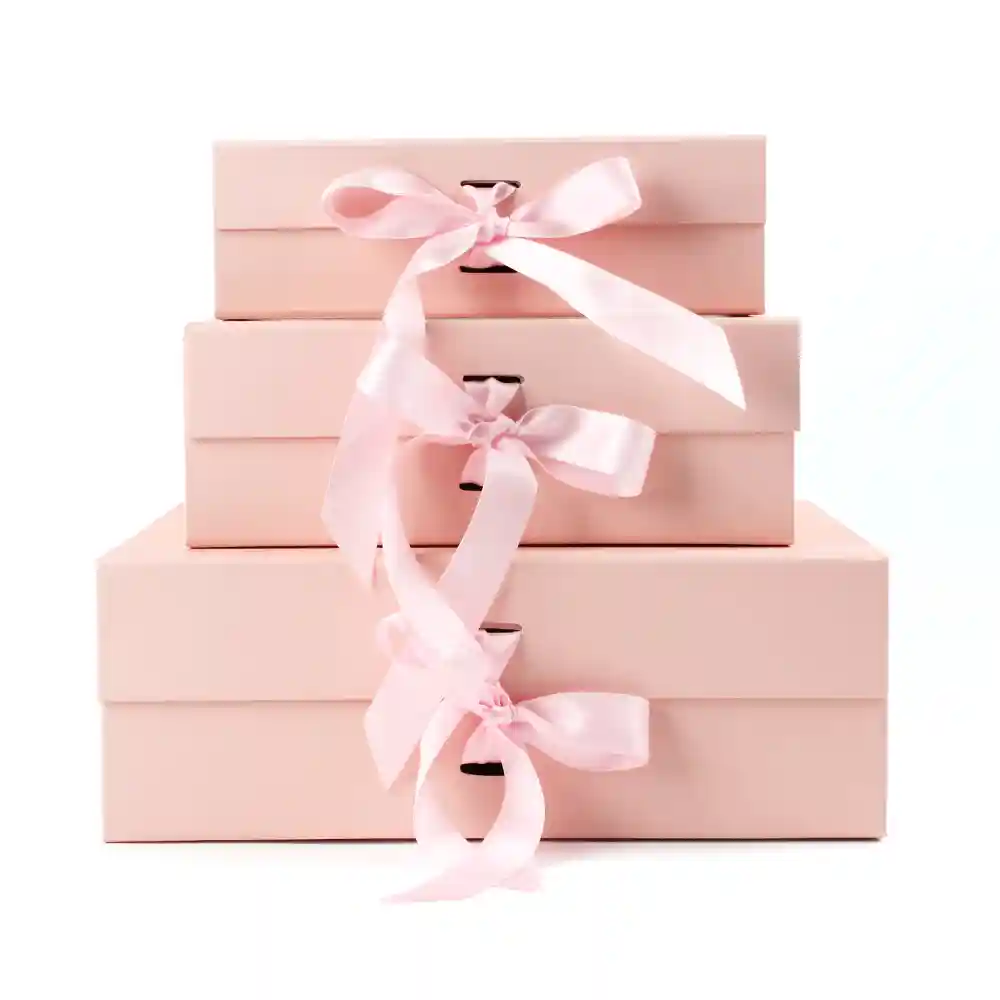
Drawer box with ribbon. For gift-set versions and premium launches. The pull-open moment justifies the extra $0.40–0.60 only when the price point supports it ($35+).
All three take the same interior hardware pocket, so one insert spec can serve the card-and-box split: same product, two pack-outs, no redesign.
Multi-Piece and Set Packaging
Sets are where keychain packaging margin hides. A 3–5 piece set boxed individually costs five inserts and five lids; the same set in one compartment tray costs one box and a partitioned insert.
Two patterns work:
- Fixed compartments for predictable sets (3 keychains + 1 bottle opener, for example) — cheapest, but locks the set contents.
- Modular tray — a base tray with removable dividers that a brand reconfigures across SKUs. Costs about 15% more than fixed, but one tray serves every set combination in the catalog.
For mixed-SKU bundles (a men’s gift set with keychain, money clip, and card holder, for instance), the modular approach is the only economical one. Qdylc builds both from 100 pieces; the modular tray’s dividers are die-cut so set changes don’t require new tooling.
Translucent Bags and the Transit Sleeve
Two low-cost additions cover the gaps between cards and boxes. A clear poly bag with a resealable flap over a backing card keeps enamel faces from scuffing against each other in bulk cartons — spec the bag 10mm larger than the card on every side, or the card won’t seat flat. And for cards shipped as parcels without a box, the kraft sleeve mentioned above doubles as a branding surface: a one-color logo on kraft reads considered, not improvised. Neither addition replaces the packaging decision; both protect it. The pattern across this category is consistent: the cheapest components (sleeve, bag, seal) carry the protection, so the visible packaging can stay minimal and the price point can stay honest.
FAQ
Should keychains be packaged on backing cards or in boxes? Below $15 retail: backing cards — the hardware is the product and should be visible. Above $25: small rigid boxes, because the gift context carries the price. In between, follow the channel: Amazon and retail hooks take cards, DTC gift orders take boxes. A $0.20 kraft sleeve over the card protects hardware in transit.
What card stock and hang hole specs prevent tearing? 300–350gsm stock, a 5mm hang hole, and the hole positioned 8–10mm from the top edge — closer tears, farther tips the card forward. Add dual-point fastening (one point through the ring, one through the clasp) so the keychain can’t rotate and tangle on the hook.
How do you package multi-piece keychain sets? One compartment tray instead of individual boxes. Fixed compartments are cheapest for a set with locked contents; a modular tray with removable die-cut dividers costs about 15% more but serves every set combination without new tooling — the only economical choice for mixed-SKU bundles.
Custom Keychain Packaging
Qdylc produces custom keychain packaging in Qingdao — backing cards to exact hang-hole specs, window and shallow rigid boxes from 100 pieces, and modular set trays that reconfigure without new tooling. Free structural drawings, 24-hour 3D mock-ups, samples credited against production, DDP to the US, EU, UK and Australia.
Latest News
How to Package Leather Bracelets Without Creasing or Moisture Damage
October 30, 2026
How to Package a Necklace for Gifting: The Definitive Guide
October 29, 2026
How to Package Bracelets and Bangles: Sizes, Inserts, and Box Types
October 29, 2026
How to Package Rings for Shipping Without Damage or Theft
October 29, 2026