
How to Package Rings for Shipping Without Damage or Theft
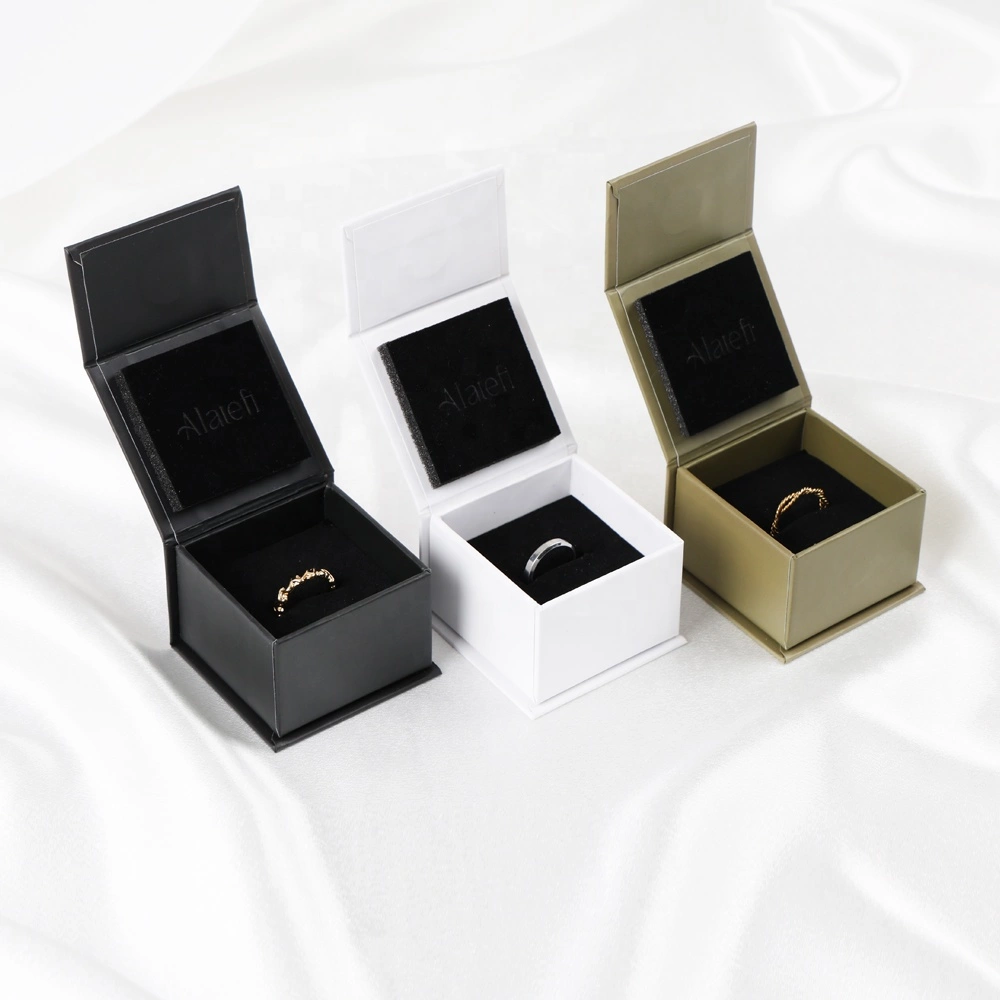
To package rings for shipping safely, use three layers: a snug inner ring box that holds the band with zero movement, a cushioning mid-layer with at least 2 cm of give on every side, and a rigid outer carton that survives a 76 cm drop. Skip any layer and the statistics turn against you — rings are the smallest and among the highest-value jewelry items per gram, which makes them the category with the highest damage and loss rates in e-commerce fulfillment.
Rings are also the most likely jewelry SKU to be shipped alone. A $200 ring in a 20-gram parcel is an attractive target for theft, easy to crush, and small enough to be lost inside its own packaging. This guide walks through the three-layer system we build for jewelry brands shipping from our Qingdao factory to the US and Europe, the inner box options compared, and five real failure patterns to avoid.
The 3-Layer Protection Rule
Think of ring shipping packaging as three concentric rings of defense, each with one job:
Layer 1 — Inner box: fix the ring. The ring box’s only job is to stop the ring from moving. The insert cavity should grip the band with light friction: close the box, shake it hard next to your ear — if you hear anything, the fit is wrong. A 2 mm gap is enough for a band to strike the lid repeatedly across a 10,000 km journey.
Layer 2 — Mid-layer: absorb shock. Wrap the box (or nest it) in material that compresses. The standard is at least 2 cm of cushioning on all six sides — bubble wrap, honeycomb paper wrap or paper shred. This layer absorbs the drops and vibration that the outer carton transmits inward.
Layer 3 — Outer carton: resist crushing and conceal value. A rigid corrugated carton (BC flute or heavier) that does not visibly say “jewelry” inside or out. It protects against crushing in sortation — where parcels routinely experience 30–50 kg of stacking load — and it gives you a surface for labels without touching the gift box.
The layered cross-section looks like this: ring → fitted insert → ring box → 2 cm+ cushioning wrap → rigid carton → shipping mailer or polybag. If any layer is missing, the layers above it inherit a job they were not designed for.
Choosing Inner Ring Boxes
Not all ring boxes protect equally in transit. Match the structure to how the parcel will actually travel:
| Inner box type | Ring security | Crush resistance | Relative cost | Best use |
| Card slot box (paperboard) | Medium — slot grips band | Low | Lowest | Hand-delivery, local courier, add-on layer |
| Rigid box + EVA insert | High — cavity fits band | High | Medium | Standard e-commerce shipping |
| Rigid box + velvet insert | High — soft grip, no abrasion | High | Higher | Premium rings, retail + shipping hybrid |
| Plastic hinged box | Medium — depends on clip | Medium | Low | Bulk B2B shipments, trays |
| Metal box | High | Very high | Highest | Ultra-premium, long multi-leg routes |
Two practical notes from our production floor:
- Paper slot boxes alone are not shipping packaging. They are presentation packaging. If you ship in one, it still needs layers 2 and 3 — most ring damage claims we see trace back to a slot box sent in a poly mailer with no cushioning.
- Velvet inserts do double duty. They grip without scratching plated or polished finishes, and they hide minor movement better than rigid EVA — useful when your insert tolerance varies between ring sizes.
For wholesale quantities, our custom ring boxes can be specified with a shipping-grade EVA insert on one side and a retail velvet face — one box serving both the courier and the customer.
Void Fill and Cushioning Options
The mid-layer material is where cost, protection and sustainability trade off:
- Bubble wrap — the benchmark: cheap, light, predictable 2–3 cm protection. Downside: plastic waste and poor brand optics.
- Honeycomb paper wrap — the eco alternative that actually works. Interlocking paper cells cushion comparably to small-bubble wrap at 2 cm+ thickness, and it is curbside recyclable. Cost runs 10–20% above bubble wrap.
- Paper shred / crinkle paper — good for nesting boxes inside a carton, less good as sole cushioning because it settles in transit.
- Molded pulp cradles — for flat-rate volume shippers, a custom pulp cradle that holds the ring box in position inside the carton eliminates void-fill labor entirely. Worth investigating above roughly 1,000 parcels per month.
Mark where the environment matters: if you ship to humid climates, add an anti-tarnish strip inside the inner box regardless of cushioning choice — sweat and humidity in a sealed parcel will tarnish sterling silver faster than any drop will scratch it.
Discreet vs Branded Outer Packaging
This is the decision ring brands get wrong most often, in both directions.
The case for discreet: plain outer cartons with no brand marks reduce opportunistic theft — sorting facilities, porches and mailrooms. For rings specifically, the consensus among fulfillment insurers is clear: never label the outer packaging with brand names or “jewelry” descriptors. Discreet does not mean ugly; the unboxing experience lives inside, in layers 1 and 2.
The case for branded: your customer’s experience starts at the mailbox. A branded outer mailer with an interior message is a marketing surface — and for lower-value fashion rings, the theft risk is low enough that branding wins.
The hybrid we recommend for most ring brands: a plain outer carton for protection and discretion, with branding concentrated on the inner box, inner-lid print and a card. The customer experiences your brand at the moment that matters — opening the box — while the parcel attracts no attention in transit. For brands that want both, a custom printed mailer with an unbranded outer sleeve gives you a removable marketing layer: see our e-commerce shipping packaging solutions.
International Shipping Tips
Shipping rings across borders adds three concerns:
- Customs declaration. Rings classify under HS 7113 (precious metal) or 7117 (imitation). Declare accurately — undervalued declarations void insurance claims and create import problems for your customer. If you source packaging and product together under DDP terms, as we offer, the exporter of record handles the paperwork and duties.
- Insurance and declared value. Standard carrier liability rarely covers actual jewelry value. Buy third-party parcel insurance above roughly $100 declared value, and keep photographic evidence of the packed parcel — insurers increasingly ask for photos of all three layers before paying a claim.
- Humidity and temperature. Sea-air moisture during a 30-day transit tarnishes silver and can warp paperboard inserts. Anti-tarnish strips inside the box plus a poly bag around the inner box is the minimum for ocean-freight restocking; for air parcels in winter, note that rapid temperature shifts cause condensation inside sealed boxes — the poly bag is what protects the box, not the ring.
Common Shipping Damage Causes
Five failure patterns account for most of the damage claims we help customers diagnose. Each is avoidable with the three-layer system:
- Ring loose in an oversized box. The most common failure: a beautiful rigid box, an insert cut for a different band width, and a ring that rattled for 12,000 km. Fix: size the cavity to the band, verify with the shake test.
- Slot box in a poly mailer, no cushioning. Poly mailers pass sortation fine — until one crushes. Slot boxes have almost no crush resistance. Fix: minimum 2 cm of cushioning and a rigid outer carton.
- Ring taped to the insert. Sellers tape bands down to stop movement; the adhesive then reacts with the plating or leaves residue on polished metal. Fix: correct insert fit, never adhesive contact with the ring.
- Tarnish reported as “damage.” A silver ring arrives dull after ocean transit; the customer claims damage; the box is fine. Fix: anti-tarnish strip inside every silver shipment — it costs cents.
- Outer carton reused or under-specified. A single-wall carton that has already been through one shipping cycle loses much of its stacking strength. Fix: new BC-flute cartons for jewelry, and drop-test samples from your actual packaging line — our standard is ISTA 1A, a 76 cm drop in 10 orientations, and we can pre-test your exact box stack before you commit to volume.
Get Wholesale Ring Boxes Built for Shipping
Qdylc manufactures ring boxes, shipping-grade inserts and outer cartons as one matched system — sized together, tested together (ISTA 1A), and shipped together. We support low-MOQ runs from 100 pieces, provide free structural drawings, and ship DDP to the US, EU, UK and Australia.